Industrial SUS304 Double-Chamber Swing-Lid Vacuum Sealers (DC-500/600/800)
Compare 500 mm, 600 mm, and 800 mm double-chamber vacuum packaging machines: <=1 kPa rotary-vane pumps, 8–10 mm wireless seal bars, and IP65 washdown decks.
Zero Idle Waiting: Load One Deck While the Other Evacuates
On a single-chamber vacuum machine, the operator stands idle for 20 seconds every cycle watching the vacuum gauge drop. Inside chamber and belt vacuum sealers and industrial vacuum sealers, a double-chamber swing-lid vacuum sealer eliminates dead waiting completely: the moment the heavy SUS304 lid swings onto Chamber B and starts pumping down to <=1 kPa, the operator unloads finished packs and arranges fresh pouches across the two seal bars on open Chamber A.
With 4 total sealing bars (2 per chamber) in 500 mm, 600 mm, or 800 mm lengths, one trained operator comfortably sustains 2.5–3.5 cycles/min (500–1,200 packs/hour).
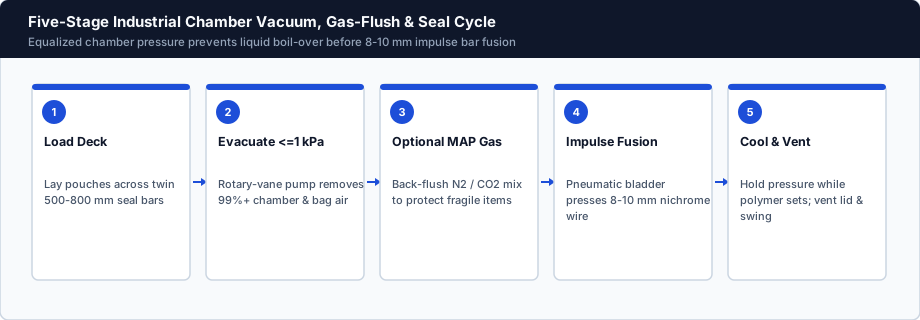
DZ/DC-500 vs DC-600 vs DC-800 Technical Specification Table
Side-by-side factory engineering dimensions and utility specs:
| Parameter | 500 Series (DZ-500-2S) | 600 Series (DC-600-2S) | 800 Series (DC-800-2S) |
|---|---|---|---|
| Seal Bar Length | 500 mm × 2 bars/deck | 600 mm × 2 bars/deck | 800 mm × 2 bars/deck |
| Opposed Bar Center Gap | 420 – 450 mm | 480 – 520 mm | 550 – 620 mm |
| Seal Wire Width | 8 mm or 10 mm (or seal+cut) | 10 mm flat or twin 3.5 mm | 10 mm heavy or bi-active |
| Rotary-Vane Pump | 63 or 100 m³/h | 100 or 160 m³/h | 160, 200, or 250 m³/h |
| Power Supply (3-Phase) | 2.5 – 3.5 kW (380V/220V) | 3.5 – 4.8 kW (380V/220V) | 5.5 – 7.0 kW (380V/480V) |
| Optional Upgrades | MAP N2 flush, soft-air, bi-active | Auto-swing pneumatic lid, Busch pump | Deep 250 mm lid, liquid slant insert |
Running heavy >3 kg primals above 1,000 packs/hour? Compare continuous belt vacuum machines.
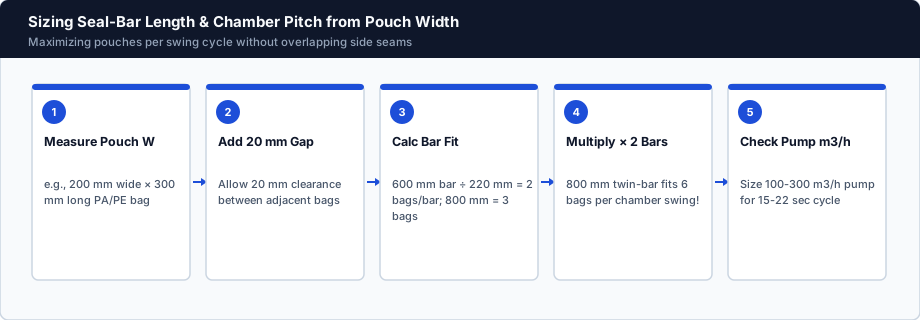
Industrial Vacuum Engineering Notes
- Flat Deck vs Recessed Tub Chambers: Always specify a flat-deck SUS304 workplate for meat/fish/cheese: liquids wipe straight off the edge during washdown instead of pooling inside a tub.
- Slanted Liquid Inserts for Soups & Sauces: Snap-in stainless incline racks hold pouch mouths angled 25° upward so curries, brines, and pickles stay clear of the 10 mm seal bar.
- Pneumatic Assisted Auto-Swing Lid: Foot-pedal or timer-actuated pneumatic lid transfer sets a steady rhythm across full 8-hour shifts without shoulder strain.
Pick 500, 600, or 800 mm for Your Pouches
Send your pouch widths and hourly targets via Project Brief.
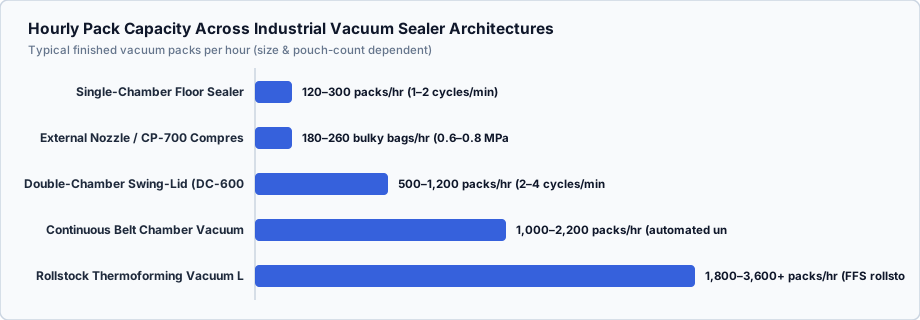
Explore related platforms in Industrial Vacuum Sealers, Vacuum Pump & Film Specs, or send your pouch sizes & hourly target via Project Brief.
Related Specifications
Further Reference
Verify Dimensions & Operating Ratings
Send your target envelope, load requirements, and ambient environment to review matching configurations.