Barrier Film Micron Thickness, OTR & MAP Gas-Mix Reference Chart
Engineering lookup chart for PA/PE, EVOH, shrink, and foil ESD bag thickness (70–180 microns), N2/CO2/O2 gas mixes, and chilled shelf-life benchmarks.
Choosing the Right Micron Gauge & Modified Atmosphere Gas Ratio
Leakers in cold-chain distribution almost always trace back to under-gauged 65 μm pouches punctured by pork bones or sharp shrimp tails—or wrong gas ratios causing collapsed trays! Grounded in vacuum sealer sizing and selection and vacuum pump and barrier film specs, reference this chart before ordering barrier film.
Note: high CO2 (>40%) dissolves into cold meat/cheese moisture and pulls tray lidding inward (‘snug-down’) unless balanced with insoluble Nitrogen (N2) filler gas.
Vacuum & MAP Film + Gas Reference Table
Recommended pouch/lidding gauge, gas mix, and 0–4 °C storage window:
| Food / Industrial Item | Min Film Thickness | Atmosphere / Gas Mix | Air Shelf Life | Vac / MAP Shelf Life (0–4 °C) |
|---|---|---|---|---|
| Boneless Beef / Lamb Cuts | 80–100 μm PA/PE or 60 μm shrink | Deep Vacuum (<=1 kPa) | 4–6 days | 21–35+ days |
| Bone-In Chops, Ribs, Crab | 140–180 μm PA/PE (+ bone guard) | Soft-air Vac (1.5–2 kPa) | 3–5 days | 14–21 days |
| Cooked Ready Meals / Pasta | PA/EVOH/PE tray + barrier lid | 30% CO2 / 70% N2 (<0.8% O2) | 4–5 days | 21–30 days |
| Hard Sliced / Shredded Cheese | 90–110 μm PA/EVOH/PE | 30% CO2 / 70% N2 | 7–14 days | 60–120 days |
| Roasted Coffee / Nuts | 100–130 μm PET/AL/PE | Vac + N2 flush (<1% O2) | 4–6 weeks | 9–12 months |
| PCB / Semiconductor Reels | 100–150 μm ESD Foil MBB | Vac + Dry N2 + Desiccant | Hours (MSL) | 12–24+ months |
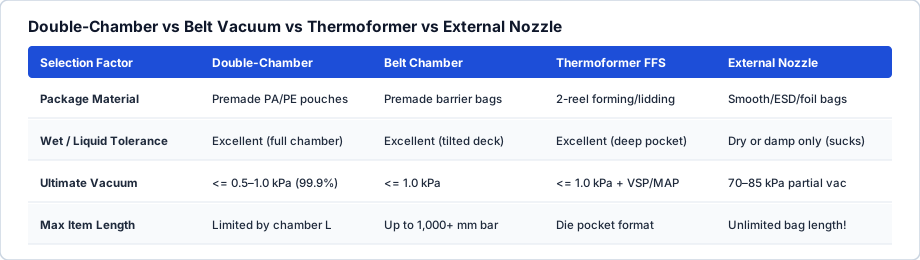
Compare tray, skin, and chamber hardware in industrial vacuum sealers.
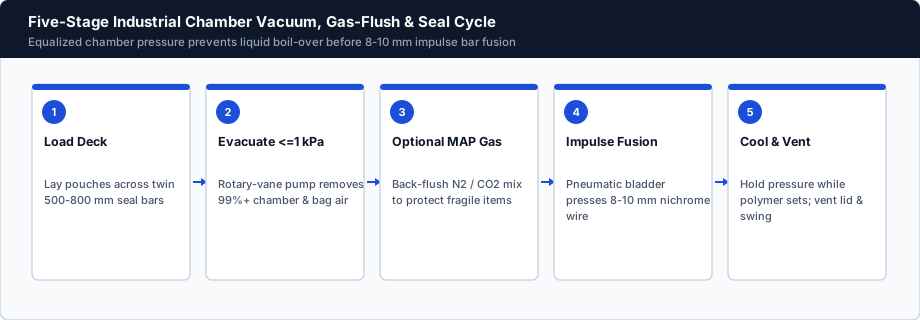
Industrial Vacuum Engineering Notes
- Never Use Channel/Embossed Home Bags in Chamber Machines: Textured ‘FoodSaver’ embossed rolls cost 3–4× more than smooth commercial PA/PE chamber pouches—chamber sealers run economical smooth 3-side-seal bags!
- Food-Grade Pre-Mixed vs On-Site Gas Mixer: Plants running <1,500 MAP trays/day use pre-mixed 70/30 food-grade cylinders; high-volume plants install an inline N2/CO2 proportional gas mixer.
- Headspace O2 Needle Analyzer QC: Destructively pierce 1 pack per hour through a foam septum to verify residual oxygen stays
<0.5–1.0%.
Match Film & Sealer to Your Product
Send your product list and target shelf life via Project Brief.
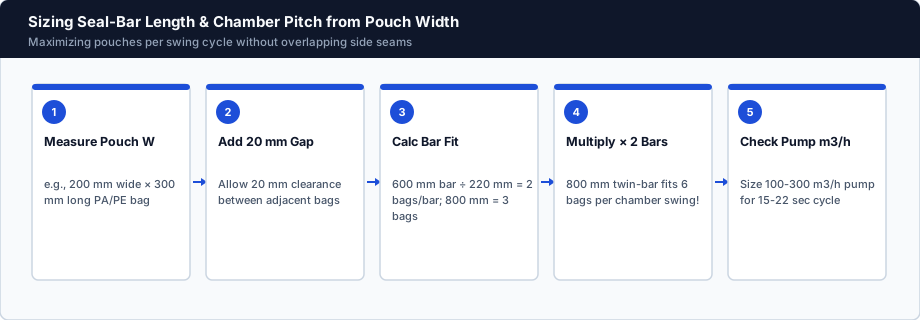
Explore related platforms in Industrial Vacuum Sealers, Vacuum Pump & Film Specs, or send your pouch sizes & hourly target via Project Brief.
Related Specifications
Further Reference
Verify Dimensions & Operating Ratings
Send your target envelope, load requirements, and ambient environment to review matching configurations.