Rotary-Vane Vacuum Pumps, Absolute kPa & Barrier Pouch Specifications
Understand rotary-vane pump m³/h sizing, <=1 kPa boiling-point cold-water flashing, bi-active vs single impulse bars, and 90–180 micron PA/PE & EVOH pouches.
Why Pump Displacement (m³/h) and Boiling-Point Physics Rule Cycle Time
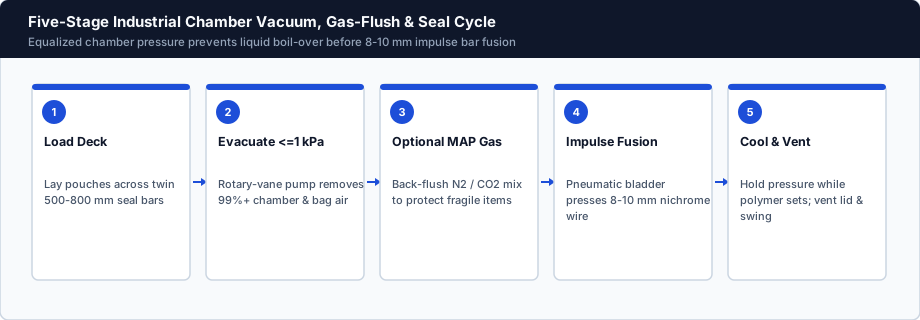
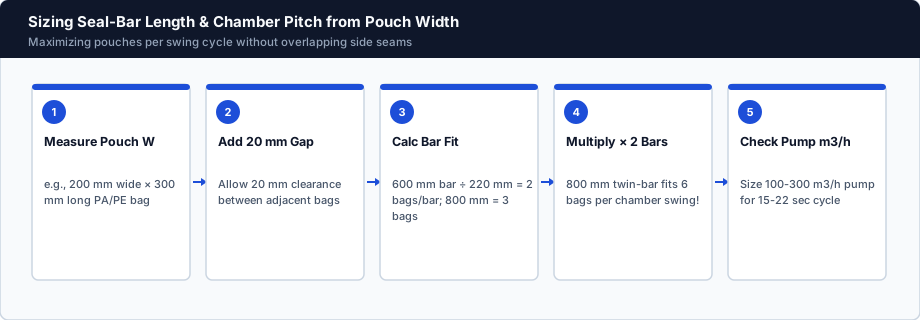
Across industrial vacuum sealers, cycle speed is governed by how fast the rotary-vane vacuum pump evacuates chamber free volume from atmospheric pressure (101.3 kPa / 1,013 mbar) down to 0.8–1.0 kPa (8–10 mbar = 99.0–99.2% air removal). Fitting an undersized 40 m³/h pump onto a deep 800 mm double chamber stretches evacuation from 15 seconds to 38 seconds—slashing shift output by half!
Equally critical is vapor-pressure boiling physics: water boils at 42 °C when chamber pressure hits 8 kPa, and boils at 17 °C when pressure hits 2 kPa! Never load warm soup or un-chilled 30 °C cooked meat expecting 1 kPa vacuum—either chill product to 0–4 °C first or use programmable millibar sensor stops to halt evacuation right before flash-boiling.
Barrier Vacuum Pouch & Seal-Bar Engineering Matrix
Match pouch polymer structure and micron thickness to seal-bar configuration:
| Pouch Structure | Thickness Window | O2 Barrier (OTR) | Required Seal Bar | Primary Application |
|---|---|---|---|---|
| Standard PA/PE (Nylon/PE) | 80 – 100 μm | ~40–60 cc/m²/24h | Single 8–10 mm impulse bar | Chilled boneless meat, cheese, veg |
| Bone-Guard Heavy PA/PE | 120 – 180 μm | ~25–40 cc/m²/24h | High-pressure / Bi-active bar | Bone-in ribs, shellfish, metal parts |
| High-Barrier PA/EVOH/PE | 90 – 130 μm | < 2–5 cc/m²/24h | Single or Bi-active 8–10 mm | 21–30 day MAP ready meals, cured meat |
| Aluminum Foil Laminate (PET/AL/PE) | 100 – 150 μm | < 0.1 cc/m²/24h | Bi-active top + bottom heated! | Coffee bricks, ESD PCBs, pharma powder |
| PVDC / EVOH Shrink Vacuum Bag | 50 – 90 μm shrink | < 10–15 cc/m²/24h | Cut-off trim wire + 85 °C dip tank | Primal beef subprimals, aged cheese |
Size your exact bar layout and pump m³/h in our chamber size & cycle calculator.
Industrial Vacuum Engineering Notes
- When Bi-Active Top-and-Bottom Heating Is Mandatory: Thick >130 μm gusseted bags, aluminum foil ESD bags, and dusty/greasy pouches require bi-active sealing (heating wires on BOTH upper and lower jaws) for reliable fusion.
- Absolute Millibar Sensor vs Simple Timer: Digital absolute pressure sensors (
mbar/kPa) trigger sealing only when true target vacuum is reached—compensating automatically whether the chamber holds 1 roast or 6 small steaks. - Food-Grade Vacuum Pump Oil & Exhaust Mist Filter: Change synthetic ISO VG 68/100 vacuum oil every 500–1,000 hours and run daily gas-ballast water-purge cycles when packing wet seafood.
Match Pump & Pouch to Your Cold Chain
Explore industry shelf-life setups in industrial vacuum applications and selection guides in vacuum sealer sizing and selection.
Send your bag micron spec and product temperature via Project Brief.
Explore related platforms in Industrial Vacuum Sealers, Vacuum Pump & Film Specs, or send your pouch sizes & hourly target via Project Brief.
In This Section
Further Reference
Verify Dimensions & Operating Ratings
Send your target envelope, load requirements, and ambient environment to review matching configurations.